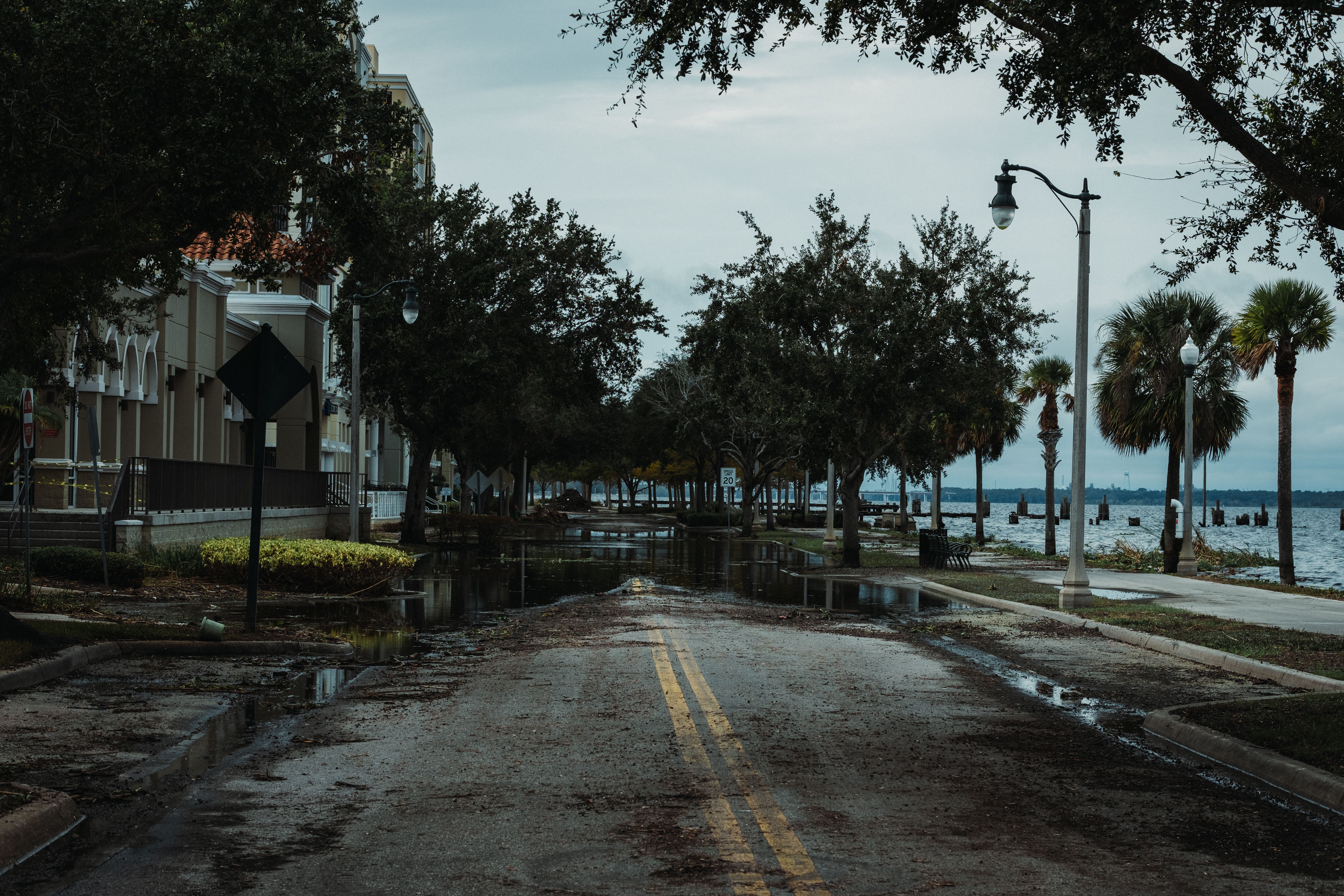
Flooding was a word from another time, and nobody used it anymore because it sounded like a bad omen. It evoked images of rushing water and submerged cars, or worse, like people standing on their roofs with their kids and dogs, waiting for help that would never come.
Now it’s called hydronetworked redistribution.
Melinda remembered the first time she heard the term, and how she nearly recoiled at the arrogance of it. Two years at the Subterra Allocation Office was all it took for her to start using it regularly in emails. Steady, gentle reinforcement was how the city got their hooks in you.
This year, the storms were heavier than ever before. It wasn’t every single day. Though it was certainly often enough that children would draw the rainclouds with teeth. There was an old drainage system that had failed progressively, then all at once. Smart culverts were introduced shortly afterwards, followed by retention corridors, pressure gates, emergency basins, and even streets designed to drown before any hospitals did.
The network knew where the water could go. There were factors that determined everything from building height, canal stress, sewer age, traffic density, insurance exposure, hospital load, school hours, household elevation, unofficial shelters, registered pets, projected litigation risk, etc.
Despite knowing almost everything, it was still a person that had to click approve.
Melinda’s job title was Senior Impact Review Associate. Her job was to look at the map and make the city’s decision feel human enough to survive court. She worked on the 4th sublevel of the Civic Weather Annex, which was entirely underground. At first everyone had made the same joke about that during orientation. They didn’t make those jokes anymore.
The desk beside her belonged to Terrence. He had three kids and a big curly beard. There was a little plastic fan hanging on his monitor that was always pointed at his face. Around the screen were sticky notes of tiny drawings from the children. Melinda liked the one with a dog wearing boots in a flood.
At 4:17 p.m., the Hoatzin storm appeared on her screen.
Storms were always named after birds. Terrence had explained that it was the protocol because birds made disasters sound like nature, and if they were just nature, then it can’t really be anyone’s fault.
Hoatzin EVENT
Projected rainfall: 19.4 cm / 6 hr
Drainage saturation: 84% and rising
Primary capture insufficient
Managed sacrifice allocation required
Melinda leaned in closer.
“How ugly is it?” Terrence asked, hearing the groan escape her.
“I don’t like it at all.”
She opened the candidate map. Three districts pulsed red. Dunning South, Old Pavel’s Basin, and Merced Downy.
Something inside her recognized Merced Downy before her mind caught up. She expanded the boundary and watched as several street names began to populate.
Ash Street was inside the flood zone. Her sister lived on Ash Street.
Melinda remained still. The office kept breathing around her. There was a whiff of garlic from something being microwaved, and the squeaks of rolling chairs.
Terrence looked over.
“You okay?”
“Yes.”
She wondered if her answer sounded fake because it was definitely fake. She called her sister but there was no answer. Then once again, still silence.
She typed: Storm might come through Merced. Are you home?
Three dots appeared and Melinda held her breath.
June: At the clinic with Niko. He’s dealing with an ear thing. Why?
Melinda exhaled cautiously. Another message came in.
June: Mom’s at my place with Battery.
Battery was June’s cat. Niko had named him when he was three and thought “tabby” was “battery”.
Melinda called her mother. Of course there was no answer. Her mother kept her phone on silent because she said ringtones were annoying. And when she did answer the phone she would only talk on loudspeaker because she didn’t like the idea of holding a “bacteria-riddled piece of metal” to the side of her head.
Meanwhile, the map had changed from bright red to a darker red. The network was doing its networking, and had refined the path.
REVIEW REQUIRED
Recommendation: Option A
Primary sacrifice zone: Merced Downy.
Projected displacement: 12,220
Projected severe injury: 28
Projected mortality: 2-7
Protected assets: West Cardinal Medical Campus, Soleil Data Exchange, Red Line transportation tunnel, municipal reservoir intake
Melinda opened Option B.
Dunning South.
Projected displacement: 9,670
Projected severe injury: 25
Projected mortality: 8-12
Protected assets: Merced Downy, West Cardinal Medical Campus, Soleil Data Exchange
Secondary risk: industrial runoff breach
Option C was the worst of them all.
Old Pavel’s Basin.
Projected mortality: 8-16.
She closed it almost immediately.
Terrence was watching next to her and had gone silent.
“You should ask for a supervisor to review it,” he finally suggested.
“There’s no time.”
“There’s six minutes.”
“That’s no time.”
“It could be enough time to make it Walton’s problem.”
Her eyes darted to Terrence, and his expression was blank.
It hadn’t started raining outside of the annex yet. The civic feed showed west-side clouds moving in low and quick. They were a blend of orange and grey, like old rusty metal.
Then, the office speakers played an alert tone. It was easily heard above any chatter in the room. The alert meant the city had entered storm posture.
Melinda’s phone vibrated.
June: Mom not answering.
June: Neighbor says lobby already has water coming in.
June: What is happening?
Melinda opened the registry for Ash Street 8829.
Occupancy: 43 residential units
Evacuation compliance: 62%
Elder residents: 11
Floodproofing status: partial
Last structural inspection: 14 months overdue
Visitor log: Catherine Brochu, 1:12 p.m.
Her mother’s name, clear as day in that stupid little box.
Walton came down the row with a tablet in his left hand and coffee in the right. His suit made him look like a supervisor. His expression made him look supervised.
“Brochu,” he said. “You have Hoatzin?”
“Yes.”
“What’s your recommendation?”
“Option A.”
“Any concerns?”
Melinda hesitated and looked back at the map.
Her mother kept honey packets in a kitchen drawer. She called all streaming services “the Netflix.” One time, she tried to mail Italian Wedding soup to Melinda’s new apartment. Not order soup, but mail it, in a mason jar.
“Merced Downy occupancy might be undercounted,” Melinda said.
Walton frowned.
“Evidence?”
“There are visitor logs.”
“How many?”
“One confirmed.”
Walton stared at her and Terrence looked at the dog in rain boots.
“One confirmed visitor is not enough to change allocation,” Walton said.
“But there could be others,” Melinda protested. She felt her voice getting smaller, like she was shrinking into a mouse.
“Are there?”
“I don’t know.”
“Then no.”
Her phone buzzed again.
June: Mel please.
Her sister still called her Mel sometimes. She said it was a habit carried over from childhood. It hurt more than her actual name would have.
A timer appeared at the top of the screen.
GATE SEQUENCE IN: 03:49
Walton lowered his voice.
“Step away if you need to.”
“I’m fine.”
“No, you’re not.”
The rain started. Not in the office, but on the civic feed. It hit the traffic cameras hard enough that the picture blurred. People started running under awnings. A bus stopped too far from the curb and all the passengers had to step through water as they exited.
Melinda opened the manual override panel.
Terrence whispered, “Melinda.”
She heard him, and ignored him.
Walton saw it.
“Don’t.”
The override menu asked for a justification.
[1] Infrastructure preservation.
[2] Shelter protection.
[3] Medical priority.
[4] Model uncertainty.
[5] Civil unrest risk.
[6] Manual correction.
[7] Other.
She chose Model uncertainty.
The screen issued the warning she had seen in training, during the drills when other people made mistakes: Manual override will redirect flood burden from recommended sacrifice zone to alternate basin. Reviewer assumes liability pending audit. Alternate basin: Dunning South.
The numbers remained in the corner.
Option A: 3-7 projected deaths. Override: 5-11 projected deaths.
The network didn’t hide it from her. That wouldn’t matter until later.
Walton shifted toward the emergency lock, prompting Terrence to stand. It wasn’t visibly dramatic or overzealous. He just moved into the narrow space between Walton and the lock panel, causing Walton to glare at him with disappointment.
“Terrence.”
Terrence said, “You won’t reach it.”
Melinda pressed her thumb to the authorization scanner beneath her desk.
Elevated emotional state detected. Confirm operational fitness?
She laughed once, and thought to herself that this must be how it feels to do honest work. She certainly didn’t think it was funny.
June called.
Melinda did not answer. She pressed Confirm.
A quiet chime filled the office.
GATE SEQUENCE MODIFIED
Primary sacrifice zone reassigned
Merced Downy protected
Dunning South receiving load
On the screen, water shifted.
It didn’t simply vanish like it was being sucked down a bathtub drain. Instead it turned and gathered under Ash Street, pulled back from 8829, and ran south through a chain of culverts toward Dunning.
Melinda watched it go.
Her mother called her two minutes later.
“Melinda?”
Melinda’s hand shook so badly that she was surprised she hadn’t dropped the phone.
“Mom.”
“The lobby is full of water. Should I be worried about this?”
“No. Stay upstairs.”
“I am upstairs. I’m not stupid.”
“Ok so just stay there.”
“Why are you breathing like that? Did you eat today?”
“I’m at work.”
“That doesn’t answer my question.”
Battery yowled somewhere in the background.
“Did you forget something?” her mother asked. Catherine usually responded to fear by pretending it was an errand.
Melinda put her hand over her mouth.
“Nothing,” she said. “I didn’t forget anything.”
After the storm, the mayor praised the network. He never did otherwise. The city operated on the idea that any disaster it couldn’t prevent would at least be managed. He stood at a podium in a bright yellow raincoat and said the allocation had protected the West Cardinal Campus, although the reservoir intake caught a bit of the runoff. West-side casualties remained within projected tolerance, and human review had prevented a larger disaster.
Melinda watched from her desk with an emergency blanket around her shoulders that Terrence had placed on her. She didn’t ask him for it, but he put it on her anyway, like she had survived something. Terrence wasn’t there anymore. He had been taken to give a statement.
Walton stood behind her. The dashboard read:
Dunning South
Displacement: 11,204
Severe injury: 19 confirmed
Mortality: pending
Pending was where the bodies floated face down, waiting for the city to get organized.
Her mother called again at 10:14.
“You saved us, didn’t you?” she whispered.
Melinda squeezed her eyes shut.
“I only did my job.”
“No.”
“Mom.”
“No.”
Melinda said nothing else.
Her mother was the one breathing into the phone now. The cat yowled again, furiously alive.
“I am grateful,” her mother said.
“I know, me too.”
“And I am angry.”
Melinda opened her eyes.
“I know.”
“What did it cost?”
The dashboard still said pending.
“I don’t know yet.”
Her mother was quiet. Then she said, “I think you do.”
Click.
The audit began the following morning before sunrise. They put her in Conference Room C with two city attorneys and an allocation ethics officer. Walton’s face appeared remotely on the wall. Terrence was still nowhere to be found.
The ethics officer introduced herself as Sherry. She wore a small silver pin shaped like a raindrop. Melinda hated it immediately and then scolded herself for noticing.
“You selected Model uncertainty,” Sherry said, more like a statement than a question.
“Yes.”
“What uncertainty did you identify?”
“Merced Downy occupancy may have been undercounted.”
“And that was based on one visitor log?”
“Yes.”
“Can you confirm that the visitor was your mother?”
“Yes.”
One of the attorneys wrote something down.
“Did you know Dunning South would receive the redirected load?” Sherry continued.
“Yes.”
“Did you see the increase in projected mortality?”
“Yes.”
Sherry looked at her for a long time but hadn’t written anything down herself.
“Why did you proceed?”
Melinda waited for an answer with enough language around it that it could stand up in the room without looking like a lie, but it never came.
“My mother was there,” she said.
Sherry nodded once. “Thank you.”
Melinda laughed.
The other attorney frowned, “Is something funny?”
“No.”
“Then why did you laugh?”
“Because she thanked me for saying I picked my mother over strangers.”
Sherry looked at her again, her expression somewhere between concern and contentment.
“It does matter that you said it.”
“For the audit, right?”
“For the truth.”
Melinda’s gaze drifted to the ceiling. The rain had stopped hours ago. She could still hear water in the walls of the annex. There were drainage channels below drainage channels. The building sounded like it was struggling to swallow a pill.
At noon, the first deaths were confirmed. Six. By two, nine more. An hour later, twelve.
The final number was seventeen and the model had been wrong. There was always a chance that the range was incorrect. Errors lived in the numbers until the names arrived.
Dunning South’s Eden Hill apartment complex had taken the redirected load through a service lane behind the building. The water overwhelmed an old channel and undermined the rear foundation before it broke through the lower stairwell. The report said the building settled. Melinda scoffed at the word and how they made it sound like the building just got tired and laid down to sleep. Most of the residents got out, but seventeen did not. Three families accounted for eleven.
She read the sealed casualty report alone because audit subjects were required to review full consequence documentation. This was part of a policy called harm comprehension. Another “humane” reform.
Anya Dobrik, 34,
Luis Dobrik, 36,
Matthew Dobrik, 5,
Clair Dobrik, 2.
She stood too quickly, knocking over the chair.
In the bathroom, both stalls were occupied, so she vomited in the sink. A short woman at the next sink kept washing her hands and didn’t look over.
Melinda looked at herself in the mirror.
“I knew,” she said. Her reflection said nothing useful in return.
Melinda had known that people lived in the alternate zone. Of course she had. People lived everywhere. People had toothbrushes and unpaid bills and rice cookers. They hid birthday presents, and kept spare keys under ugly rocks or slept through sirens.
Terrence came to see her that night. She was back in Conference Room C. The attorneys had left. On the table was a container of noodles that someone had brought hours ago that were now soft and cold.
“I’m suspended pending further review,” he said.
“I’m sorry.”
“You’re not, and I don’t think that you should feel like you have to be sorry.”
She didn’t have the strength to argue. He sat down across from her.
For a while, the building kept swallowing.
After a few minutes, Melinda asked, “Why did you stop Walton?”
Terrence rubbed his forehead. “I don’t know.”
“You do.”
“My kids’ school is in Merced Downy.”
Melinda started to say something but stopped.
“They weren’t there,” he said. “They were at home. But I saw Merced on the map and thought about the music room in the basement. They have cubbies there. I thought, not there.”
“So you helped me, then.”
“I hesitated.”
“You stepped in front of him.”
“It was maybe three seconds.” He looked sick.
“Maddie says I should be grateful.”
“Are you?”
“Yes,” he sighed. “That’s the problem.”
They both looked at the casualty report on the table.
“There are others,” Terrence said matter-of-factly.
“What?”
“Other overrides.”
“Well yeah, I know there are overrides.”
“No, I mean…unofficial overrides. Personal ones.”
The building was suddenly not gurgling.
“What are you talking about?”
Terrence looked toward the closed door.
“There’s an archive. It’s classified. Or unofficial, whatever. Allocation reviewers pass it around, and some supervisors see it, too. Manual overrides used for personal reasons but coded as something else, usually uncertainty or infrastructure or civil unrest.”
Melinda didn’t know how to respond.
“How many? A lot?”
“I don’t know.”
“How many?”
“A lot.”
Terrence spoke quietly.
“Walton did one in 2049. It looks like he protected his brother’s dialysis center, and that flooded an industrial dormitory. Eight people died. Sherry’s supervisor did one before ethics. My trainer showed me the archive during my first year.”
“Why would they show you that?”
“I guess so I would know that it happens.”
Melinda stood.
“No,” she huffed.
“I know.”
“No, it’s not – ”
“Melinda.”
“You’re seriously telling me the system knows this happens and nobody does anything about it?”
“I’m just telling you what I know.”
“But why?”
Terrence pressed his palms over his eyelids, and his fingers gently massaged the top of his head. “From what I understand, it helps people keep working after.”
Melinda held out her hand.
“Give me your key.”
“No.”
“Terrence, please.”
“If they trace it, it won’t end well.”
“Terrence, I killed seventeen people.”
He flinched as Melinda’s mouth twisted into a painful grimace and gave her the key.
The override archive looked like everything else the city made. Whitish-grey background, dark blue headings, and an unusually clunky navigation interface. She scrolled past Manual Allocation Deviations and then again past Restricted Contextual Reference.
Storm Finch: reviewer protected spouse’s workplace. A-Zone: 4 deaths
Storm Ibis: supervisor preserved council housing complex under legal pressure. A-Zone: 23 deaths
Storm Heron: medical exemption cluster manually weighted. A-Zone: 9 deaths
Storm Kestrel: reviewer protected undocumented shelter after activist petition. A-Zone: 14 deaths
Storm Oriole: executive override preserved waterfront tax district. A-Zone: 41 deaths.
Melinda realized that not all of them were entirely selfish. Somehow that was worse.
People had moved water for brothers, shelters, hospitals, schools, donors, churches, friends, strangers whose stories reached the right person in time. Bad reasons. Good reasons. Reasons that would sound defensible if you heard them before you saw the bodies floating face-down.
The water had taken all of them.
She found Walton.
Storm Wren: protected East Briar Medical Cooperative. Reviewer disclosed familial connection post-event. Alternate zone: Marlow Dormitory. Mortality: 8. Reviewer retained. Counseling recommended.
She found one file from seven years ago where a reviewer had refused to deviate from the model even though his own apartment building was in the sacrifice zone. Six dead. The reviewer resigned. Then, one month later, he committed suicide.
Melinda closed the archive.
Then she started laughing. Quietly at first, then harder. Giddy, breathless laughter that hurt her chest.
The archive had given her the reassurance that she not uniquely monstrous and terrible and selfish and all the other things.
Between the forms and the counseling paths, it was clear that the office had absorbed this before. The archive proved that catastrophe became ordinary if enough people committed it from the same chair.
In one note, a phrase appeared in her mind and would not leave: Reviewer moral injury within expected bounds.
She laughed until she coughed on her own spit and had to wipe away tears.
The next morning, Sherry returned. Melinda had been unable to sleep the entire night.
“You accessed restricted historical material,” Sherry said.
“Yes.”
“Why would you do that?” Sherry’s tone didn’t sound alarmed or upset.
“I wanted to know if I was the only one.”
“You weren’t.”
“No, guess not.”
Sherry sat across from her.
“How did that affect you?”
“It helped me.”
Sherry didn’t look surprised.
“That’s not uncommon,” she said flatly.
“Of course it is.”
“It usually changes.”
“To what?”
“Something less helpful.”
Melinda looked at Sherry’s silver raindrop pin.
“Did you ever make one?”
Sherry’s face barely moved. That was enough.
“So you did,” Melinda said.
Sherry folded her hands in front of her on the table.
“This meeting is about your event.”
“No, it isn’t.”
“Ms. Brochu— ”
“The system is built to let us make personal exceptions, then it makes sure we never say anything.”
“No, it just manages unavoidable harm.”
“And who decides which harm gets called unavoidable?”
Sherry eyed her carefully.
“You may want to save that for counsel.”
“Am I getting a public inquiry?”
“Seventeen people are dead.”
Fear shot through Melinda’s bones so fast it made her dizzy.
Her mother would see it. June and Niko someday. Everyone would see her face and her name and the choice she made.
Sherry scanned her face and said softly, “There is another option.”
Melinda held back an anxious laugh.
“What’s that?”
“You resign. Enter sealed-review resolution. The city accepts procedural liability. Your name remains confidential under reviewer protection statute. The event is recorded as allocation failure pending system reform.”
“So you can hide me?”
“I can offer a mechanism.”
“Why would you?”
“To prevent personal retaliation. To preserve the review process.”
“To keep the office alive.”
It was clear that Sherry wasn’t going to deny it.
Melinda thought of accepting. She could move somewhere inland, get a job no one needed to understand. She could call her mother on Sundays and send Niko birthday money. She didn’t have to be a terrible person, just a person who had done a terrible thing and not be asked about it ever again.
“What happens if I refuse?”
“Public inquiry with possible charges. Then civil claims, professional exclusion. You take on a lot of personal risk.”
“And what about the archive?”
Sherry went still. “What about it?” she asked.
“It becomes evidence, right?” Melinda replied.
“That depends largely on disclosure rulings.”
“Can I disclose it?”
“No.”
“Can I mention it?”
“You can try.”
Melinda smiled.
“You’re very good at this.”
“I’ve had practice.”
There it was again. Guilt recognizing guilt.
Melinda looked at the sealed packet in front of her. Seventeen names. She knew only a few by heart, which felt like another failure.
“I want the inquiry,” she said.
Sherry closed her eyes for half a second.
When she opened them, Melinda thought she saw relief. Or envy.
“Then I have to read the consequences.”
“I know them.”
“No,” Sherry said. “You only know the projection.”
Melinda nodded and said, “Read them.”
The inquiry began nine days later. The city fought to keep the archive out. The city fought nearly everything. That was what cities did when they wanted to survive their own documents. The families from Dunning South came every day.
Catherine was there, too.
Melinda had asked her not to. Her mother came anyway and sat beside June and Niko. Niko wore a shirt with a cartoon whale on it and kept asking whether Battery was going to testify. June kept telling him no, because Battery had not witnessed the storm. Niko said Battery had emotional evidence.
The families from Dunning South sat across the aisle.
Walton, Sherry, and Terrence testified. The archive became a fight that lasted three days. The lawyers argued over continuity privilege, reviewer protection, systemic relevance. The judge looked tired of every word before it arrived.
When Melinda finally spoke, her voice sounded almost normal.
She described the map. Option A. Option B. The messages from June. Then the visitor log and projected deaths. Her mother’s name. She didn’t say she was confused, because she believed she wasn’t. It was never a question that people were going to die, but nobody had forced her to do anything.
The inquiry chair asked, “Did you understand that redirecting the flood burden to Dunning South could result in greater loss of life?”
“Yes.”
“Why did you approve the override?”
Melinda looked at the families.
Her attorney had told her not to. Looking could be read as performance. She did it anyway.
“My mother was in Mercy Row,” she said.
A sound moved through the room. Not quite a gasp, something smaller. Catherine lowered her head.
Melinda continued, “I saved someone I loved by sending the water toward people I did not know.”
The city attorney stood and quickly said, “Objection.”
The chair snapped, “Sit down.” The attorney sat.
Melinda used her right index finger and thumb to stroke her left pinky.
“I want to say I’m sorry,” she said. “I am. But I know that doesn’t mean enough.”
She looked at the Dobrik grandparents. They had sat in the same seats every day. The grandmother held a folded tissue she never used.
“I knew the water would go somewhere,” Melinda said. “I chose where.”
That sentence left the room without her.
People put it on signs. They painted it in graffiti on flood walls. They said it in other cities when officials brought out maps and used soft voices. Melinda hated the sentence because it was true.
Months later, after the archive became public, after Walton resigned, and Sherry disappeared into leave, and when Terrence moved his family inland, and the city renamed Managed Sacrifice Allocation to Emergency Distributed Burden and everyone hated the new name immediately, Melinda visited Dunning South.
Merrin House was gone. In its place was a fenced rectangle of mud, gravel, broken concrete, and standing water. Blue and grey ribbons had been tied to the fence, some with names written on them. Her mother came with her.
Melinda had not asked.
They stood by the fence under a low sky.
After a while, Catherine said, “I’m glad I’m alive.”
Melinda closed her eyes.
“I know.”
“I am ashamed of why.”
Melinda nodded.
Rain began, and neither of them opened their umbrellas. Water gathered in the lot and moved around chunks of concrete, finding the lowest places first. Melinda had once found comfort in the fact that water had no malice. Now she knew that was only half of it. Water went where it was allowed. She stepped through the gap in the temporary barrier where someone had bent the metal back. Mud covered her shoes. Rain ran down her face. She kept walking until she stood in the middle of the lot and the water began rising around her.
Her mother said her name once, sharply.
Melinda did not respond.